Mecânica Quântica: o obstáculo principal não é a matemática, mas a intuição
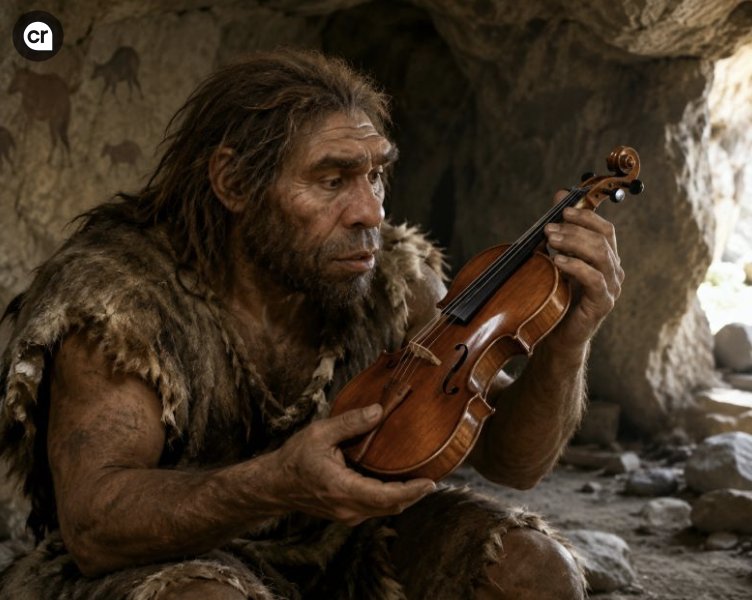
In Quantum Mechanics, the main obstacle is not mathematics but intuition.
In Quantum Mechanics the surprise may be that sapiens, meaning creatures evolved on the African savanna, can understand it at all.
It is not be that quantum mechanics is strange, that is we are trying to understand the quantum world using a brain that evolved to understand falling fruit and running animals.
In that world, objects are large, slow, and localized. A tiger is either behind the bush or not. A stone is either on the ground or not. Evolution never needed to prepare us to understand waves or, something we named electrons.
The main obstacle is not mathematics but intuition.
When we hear:
“The electron is spread out like a wave.”
our brain immediately tries to translate that into:
“So where is the actual little thing?” “Nowhere replies the guy”.
Sapiens go crazy.
But quantum mechanics suggests that the question itself may be wrong.
A useful analogy is a musical note.
If the Maestro asks:
“Where exactly is the note C played by a violin?”
The note isn’t sitting at one point in the room. It is distributed throughout the air as a wave.
Yet the note is real. It’s a wave.
Better go back to the Savanna.
In modern quantum field theory, the most fundamental entities are fields filling all of space. What we call an “electron” is more like a localized ripple in the electron field, just as a wave on the ocean is a localized ripple in water.
In that picture:
- The field is everywhere.
- The ripple can spread.
- Measurement makes the ripple appear at a particular place.
Perhaps matter is not really made of tiny solid objects at all.
We are trying to understand the quantum world using a brain that evolved to understand falling fruit and running animals.
#QuantumPhysics #QuantumComputing #DeepTech #Innovation #ScientificThinking #FutureOfTechnology
Perguntas frequentes
- Por que a mecânica quântica é difícil de entender?
- Porque o obstáculo principal não é a matemática, e sim a intuição: o cérebro humano evoluiu para interpretar objetos grandes, lentos e localizados, como frutas caindo e animais correndo — não campos e ondas.
- Onde está o elétron, afinal?
- A pergunta em si pode estar errada. Na teoria quântica de campos, o elétron é uma ondulação localizada no campo eletrônico; a medida é que faz essa ondulação aparecer em um lugar determinado.
- Qual é a analogia da nota musical?
- Perguntar onde exatamente está a nota dó tocada por um violino não faz sentido: a nota está distribuída pelo ar como uma onda — e ainda assim é real. O mesmo vale para partículas quânticas.